Your AI agent has needs. Are you meeting them?
•
4 minute read.

Key takeaways:
- AI agents without full data access don't fail visibly—they guess confidently, turning invisible errors into costly business decisions.
- Poor agent context isn't just a quality issue—it directly inflates token costs and risks real revenue loss from misdiagnosed problems.
- High-performing agents depend less on the model and more on six environmental factors—from clear goals to multi-agent orchestration.
Imagine a new colleague walks into the office on their first day. Sharp, motivated, ready to contribute. They sit down at their desk, open their laptop and start looking for what they need to do the job.
Some files are there. Most aren't. The ones they can access are scattered across folders with names like "Final_FINAL_v3" and "Do not use." No one told them what success looks like. No one connected them to the systems that hold the real data. So they do what anyone would—work with what they have. Fill the gaps with inference and try to get things done.
This is the experience most AI agents have. Every day.
When an agent looks for data and can't access it, it doesn't stop and wait. It infers. Inference without evidence is, by another name, hallucination. When it finds data that's poorly structured or inconsistently labeled, it makes its best guess about what matters. And that guess may not be accurate.
The output still looks confident. The error is invisible—until it isn't.

But there's a second problem. And it’s hidden.
A poor agent experience isn't just a quality problem. It's an operational expense.
Tokens. That's how Anthropic, OpenAI and Google bill you. When an agent lacks context, it doesn't stop—it searches, backtracks and re-reasons until it finds a path forward. That extra work isn't free. It's a line item that grows every time an agent works around a gap instead of through it.
An agent with the right context doesn't need to compensate. It reasons directly. It infers with evidence. And that efficiency shows up fast—not in a quarterly review, but on next month's bill.
That's a concrete, measurable ROI. Not just better outputs. Lower operating costs. But there's another ROI you won't see on any bill. It's the cost of misdiagnosing a problem and acting on it—incorrectly.
An agent without access to experience data won't identify churn risk as a relationship problem—it will call it a pricing problem. So it offers a discount to a customer who needed a fix. It misses the warning signs when a relationship goes dark. The customer leaves—and the revenue impact compounds.
Multiply that across every decision that agent touched, and the cost isn't a line item. It's a portfolio of preventable churn.
When Walker helps an organization improve the experience of its agents, we don’t just improve efficiency. We demonstrate ROI.

Six things every agent needs.
People aren't thinking about what AI agents need. They're thinking about what AI agents can do for them. Understandable—and also a mistake.
If you want an amazing experience with AI agents, you have to start by delivering one for them.
An agent's performance is a direct function of the environment you build around it. And every agent needs these six things to be successful:
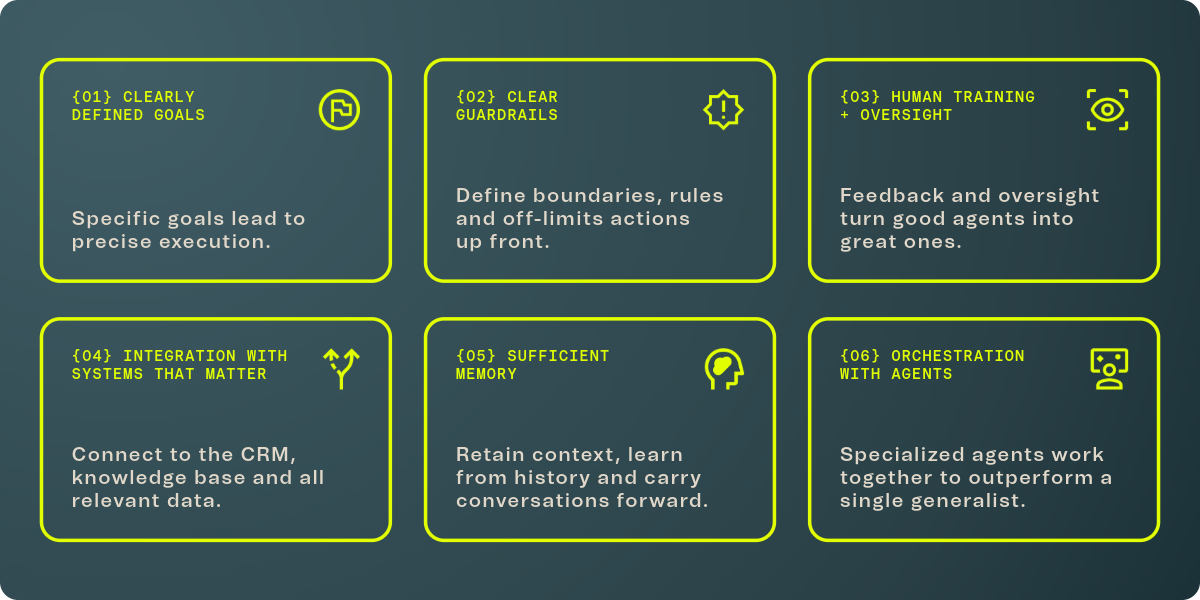
- Clearly defined goals. Agents work best on specific jobs. The more precisely you define the task, the more precisely the agent can execute it. "Help with customer experience" is not a goal. "Identify and route recurring themes from post-interaction surveys within 24 hours" is. Narrow the scope—agents that try to do everything tend to do nothing particularly well.
- Clear guardrails. Know what the agent should not do—and tell it. Define scope boundaries, escalation rules and off-limits actions before the agent encounters them.
- Human training and oversight. Agents improve with feedback. Building in regular review—humans checking outputs, correcting errors, refining instructions—isn't a sign that the agent is failing. It's how good agents get better.
- Integration with the systems that matter. An agent disconnected from critical tools and knowledge bases will make inferences that aren't based on real data. Those inferences will be wrong. And the extra processing time caused by the data gap will increase spend. Instead, connect it to the CRM, the listening platforms, the knowledge base, the ticketing system—every relevant source of data.
Output quality scales with connection quality. - Sufficient memory. An agent that can't retain context across interactions is starting from scratch every time. That's inefficient for the agent and frustrating for the humans relying on it. Give agents the memory architecture to carry context forward—session history, decision logs, prior outcomes.
- Orchestration with other agents. Complex workflows often need more than one agent. A well-orchestrated multi-agent system—where each agent owns a specific step and passes work to the next—outperforms a single generalist agent trying to handle everything. Think of it less like one very capable person and more like a well-run team.
The humans win when the agent does.
Most organizations are asking: what can AI agents do for the company? The better question is: what can the company do for them?
The agents that deliver real business impact aren't the ones with the most impressive underlying models. They're the ones with clear purpose, clean data, the right connections and humans who stay engaged. Building that environment isn't a technical afterthought. It's the whole job.
When agents succeed, the humans working alongside them succeed. That's not a side effect. That's the point.
Walker helps organizations close the gap between what AI can do and what AI is actually doing—by building the structures, integrations and oversight models that let agents perform at their best.
Walker works for our customers. And their agents.

