Turning an NPS goal into a 90-day plan for a global vehicle rental agency.

Key takeaways
- Data pointed Walker to four problem areas, and a day on the floor confirmed all four. Billing hit hardest—85% of customers with a billing problem became detractors.
- Location managers turned 38 ideas into three fixes they chose themselves. Ideas that needed corporate sign-off went on a list for leadership.
- All three fixes were live in two weeks. Each action has an owner, and the location team tracks NPS at 30, 60 and 90 days against whether customers experienced each change.
At a global vehicle rental agency’s highest-revenue location, the Net Promoter Score (NPS) stood at 27. The goal was 50.
The agency had more than 130 million survey responses across all locations. What it didn’t have was a clear view of what to fix, or how.
They needed a plan, and Walker believed that plan would hold only if the people at that location owned it. So we set out to build one with them.
Where to look isn’t what to fix.
Working alongside the agency’s CX team, we moved the raw survey responses from Qualtrics into Databricks to analyze it more easily and combine it with other types of data. We analzyed data from the five locations with the highest revenue and traced what drove satisfaction at each. The causes differed sharply from site to site, from a shuttle line that crawled through traffic at one to dusty returns at a desert location and a shortage of minivans at a family-travel market.
We started with the highest-revenue location. Four causes stood out there: shuttle waits, exit gate lines, wayfinding and billing. Billing hit hardest, with 85% of customers who had a billing problem becoming detractors.
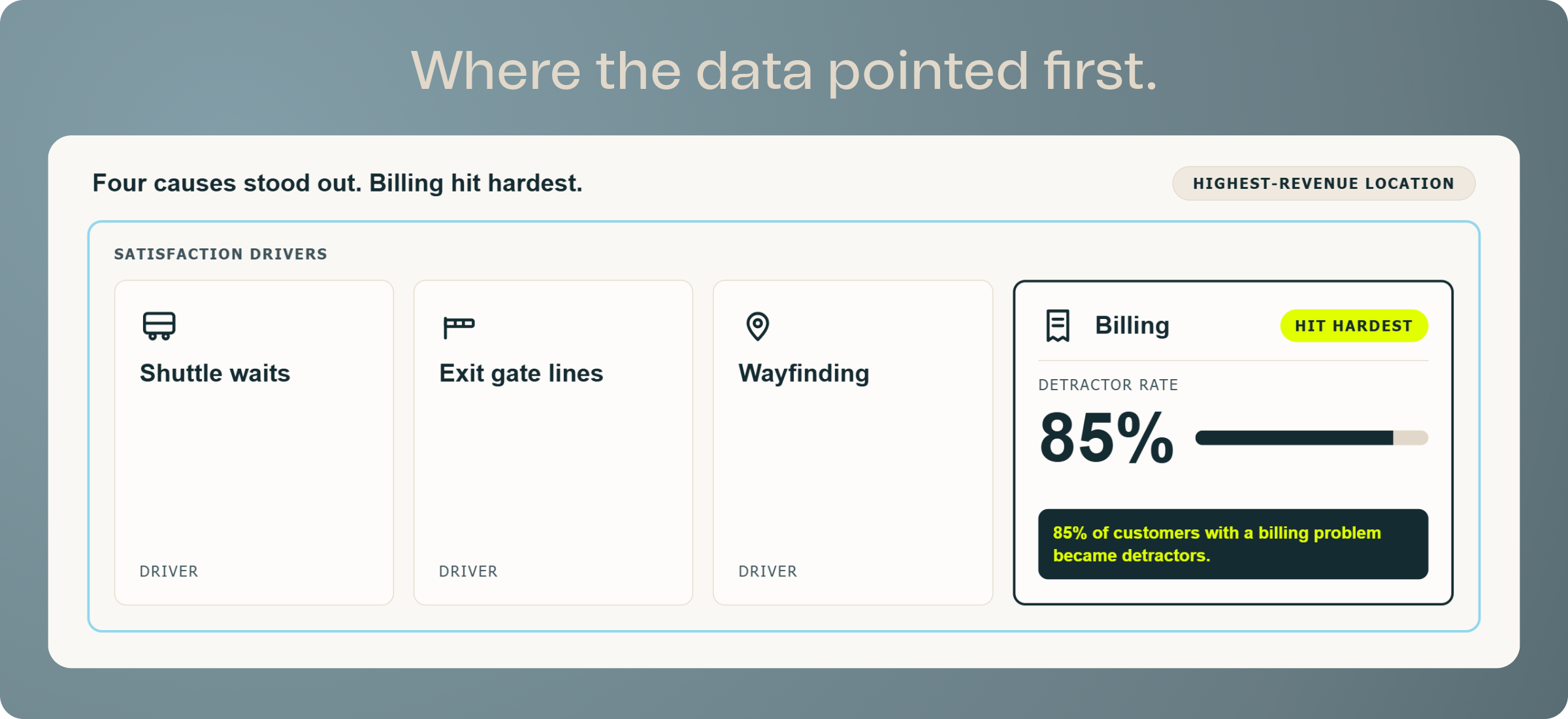
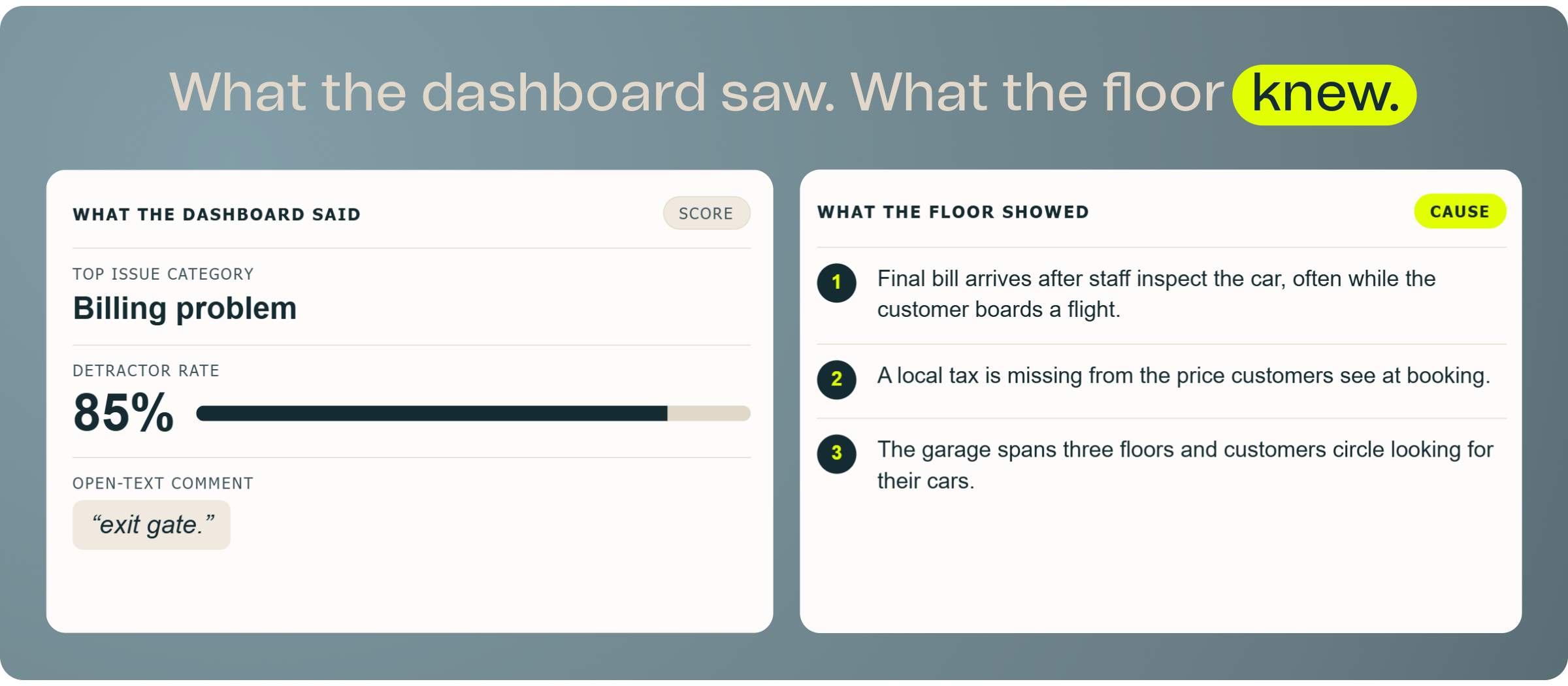
Billing traced to a local tax that never appeared in the price customers saw up front. The final bill landed after the car came back for inspection, often when the customer was already on the way to a flight and no longer standing in front of an agent.
The data told Walker where to look, not what to fix. A root cause on a dashboard is still a hypothesis, and a plan that rests on the wrong one gets expensive fast. So Walker proposed two days on site: one to test the data on the floor and one for a planning session with the people who run the location.
Walking it the way they walk it.
The agency’s leaders wanted exactly that kind of visit: a team on the ground, walking the same steps the managers walk every day, not corporate telling location managers what to fix over a video call. The data would back up what the team saw, not lead it.
On the first day, Walker’s team walked the customer journey with agency leaders, from the shuttle to the return lane. The floor validated all four causes, and then some. Day two, a planning session, would turn that into a plan.
An audit checks what’s happening. This visit asked whether the data holds up when the people who run the floor see it too.
Dream big. Reality check. Land the plane.
Day two moved from the floor to a conference room. Location managers and agency corporate leaders sat down with Walker’s team for a planning session that would end in decisions, not a findings readout.
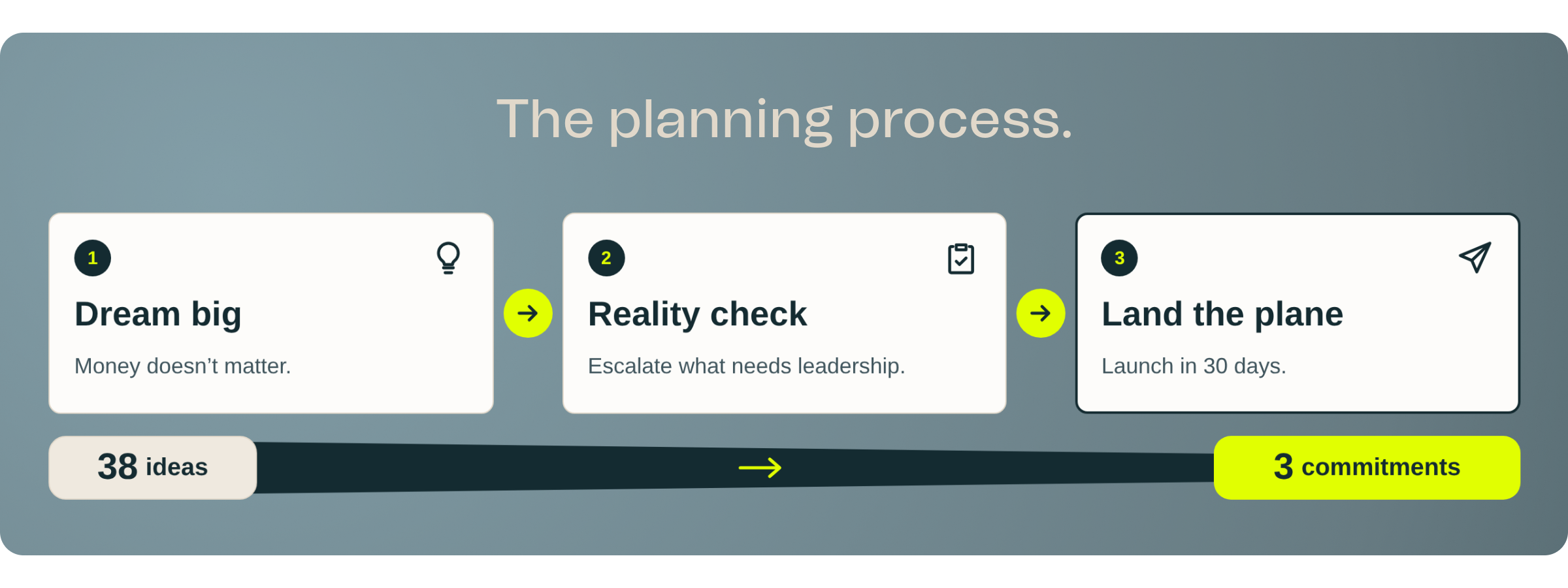
Walker did the pre-work, built the structure and facilitated both days. In the room, everyone wrote ideas on sticky notes and put them on the wall, and Walker guided the group’s 38 ideas through three stages:
- Dream big. What would fix it if money didn’t matter?
- Reality check. What needs a leadership decision?
- Land the plane. What can the team launch in 30 days?
Some of the biggest ideas—like vouchers that agents at the counter could offer customers—needed corporate sign-off, so Walker put those on a list for leadership. The location chose three it could start on its own:
- An aspiring manager at the return lane who answers questions and explains charges before customers leave.
- A top-tier exit lane where an attendant walks members through every charge.
- A concierge cart in the garage that greets top-tier members and takes them to their cars.
The managers leaned in, and because they chose the fixes, they carry them out.
Live in two weeks. Proof still to come.
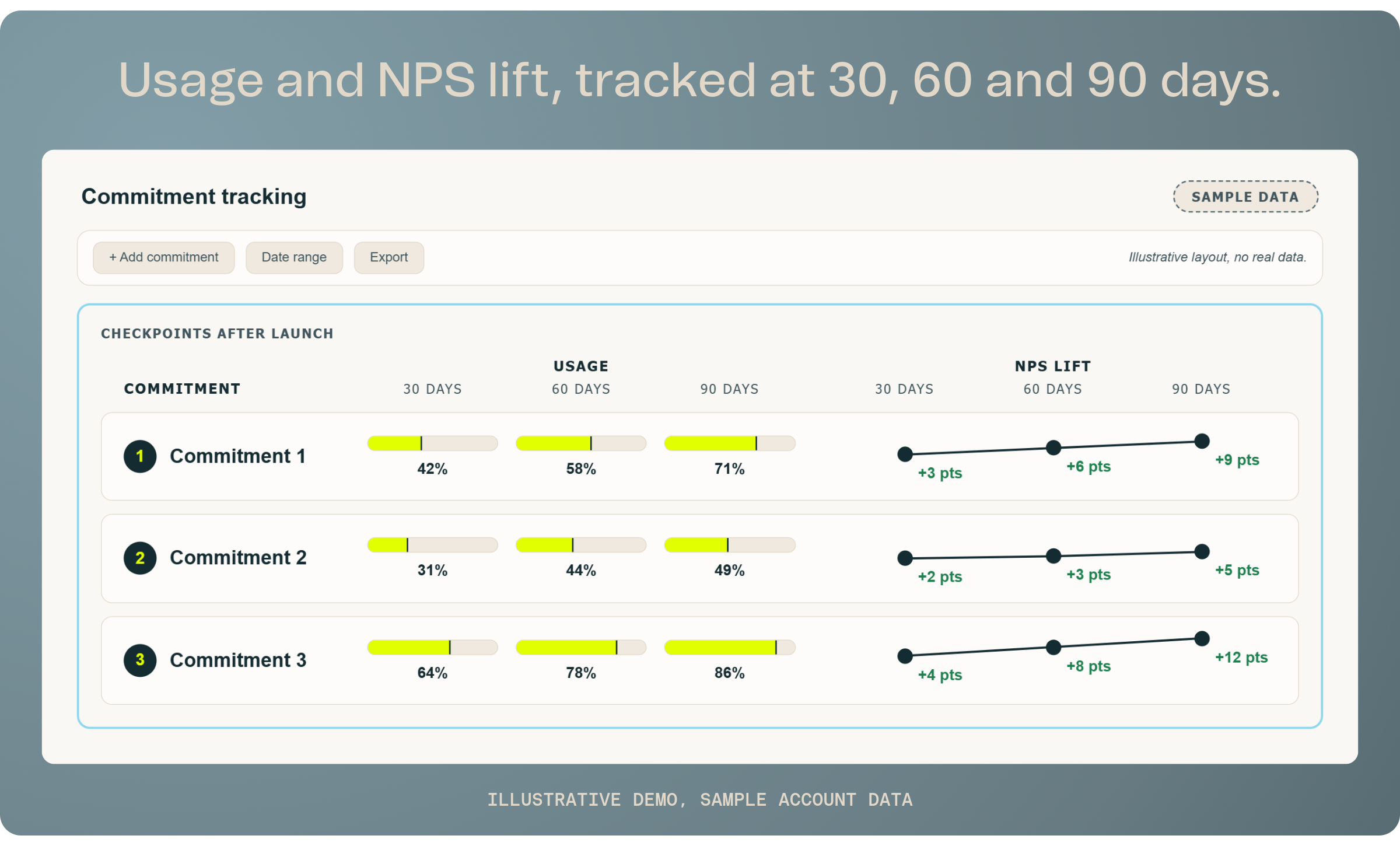
The agency left the visit with a 90-day plan and an owner for each action, and two weeks later all three commitments were live.
Tracking is part of the plan: a survey block for that location alone asks customers whether they experienced each change, and the team compares that usage with NPS at 30, 60 and 90 days.
The plan carries a risk: walking customers through every charge at the exit could lengthen the line, and the tracking will show whether the score rises or falls.
Hundreds of locations share the agency’s name, and nobody can visit them all. But a visit calibrates the analysis, so the data and customer comments carry further at the sites the team can’t see in person. If the three commitments work, they can travel too.
A target becomes a plan when the location owns it.
Data finds the problem, a day on the floor explains it and a planning session turns it into commitments the location chose.
On this engagement, Walker connected all of it: the root-cause analysis, the on-site validation, the planning session and a 90-day plan with tracking.
Your highest-revenue locations are the ones you can least afford to guess about. Find out what’s behind their NPS and build a plan the location teams own.
Let’s talk.
Additional Resources

