Stop a low HCAHPS score before the patient leaves the building.
•
6 minute read

Key takeaways
- HCAHPS surveys reach patients after discharge—too late to change what already happened.
- A one-point rise in a hospital's HCAHPS Star Rating tracks with an 8.8% jump in net patient revenue per discharge.³
- Walker is designing a model that flags risk while the patient is still in care, while their experience—and survey score—can still be improved.
A patient checks out of the hospital on a Tuesday. After leaving, a survey reaches that patient, asking how their visit went.
By then, it's too late to change what they report. The nurse who explained a new medication too fast. The hour spent waiting on pain relief. The discharge instructions nobody double-checked. Whatever happened, happened. The survey doesn't change any of it. It just reports it.
The scorecard everyone's optimizing for is already in the past.
HCAHPS—the survey patients receive after a hospital discharge—is the first national, standardized survey that publicly reports how patients rated their inpatient hospital care.¹ Hospitals have built entire operating models around it—staffing ratios, rounding scripts, incentive structures—all pointed at a number that only shows up after the fact.
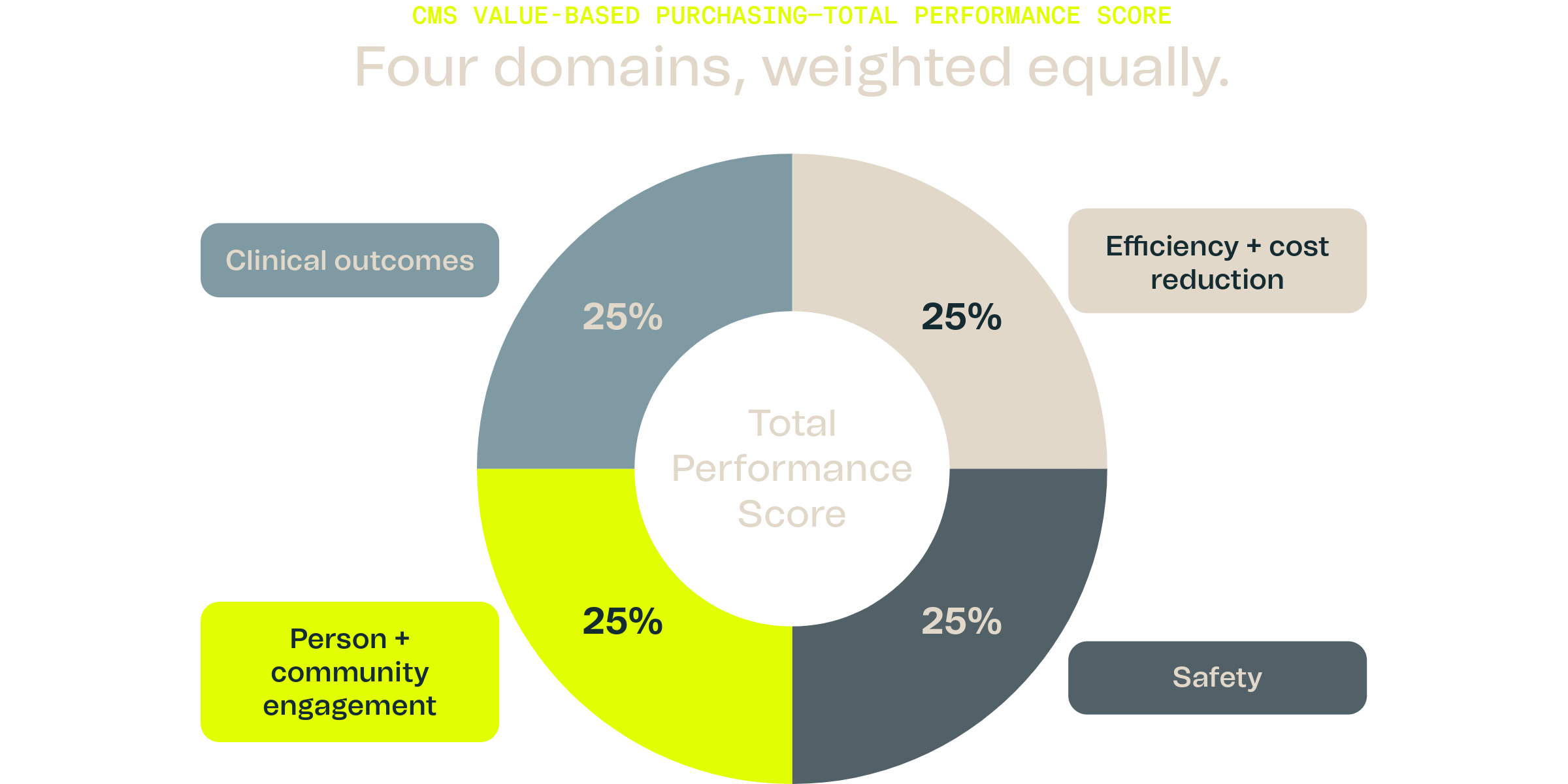
Patient experience makes up 25% of the score that determines a hospital's Medicare reimbursement—the same weight clinical outcomes carry in that same formula.² The tie to revenue doesn't stop at VBP. A one-point increase in a hospital's HCAHPS Summary Star Rating is associated with an 8.8% increase in net patient revenue per discharge.³
A hospital can study last quarter's scores, retrain staff and rewrite workflows—and still miss the patient in room 412 right now, having the exact experience that leads to a low one. Reacting to patient experience ratings isn't enough. It's time to start predicting them.
What if the risk showed up while the patient was still admitted?
Walker's HCAHPS Early Warning System answers that question—built inside the data cloud a hospital already runs, not a new platform bolted on top.
First, Walker completes the fragmented view hospitals have of their patients. Behavioral data like demographics and health characteristics, and operational data like visit history, are structured and quantitative. Experience data—what patients say in rounding notes, survey responses and contact center calls—is different: rich, human and unstructured. Sentiment analysis, powered by AI, turns what a patient said into a numerical score. Once experience data is scored, it connects with behavioral and operational data in one data cloud—Snowflake or Databricks, whichever a hospital already runs.
Now, a hospital sees the full picture: not scattered fragments, but one patient, whole.
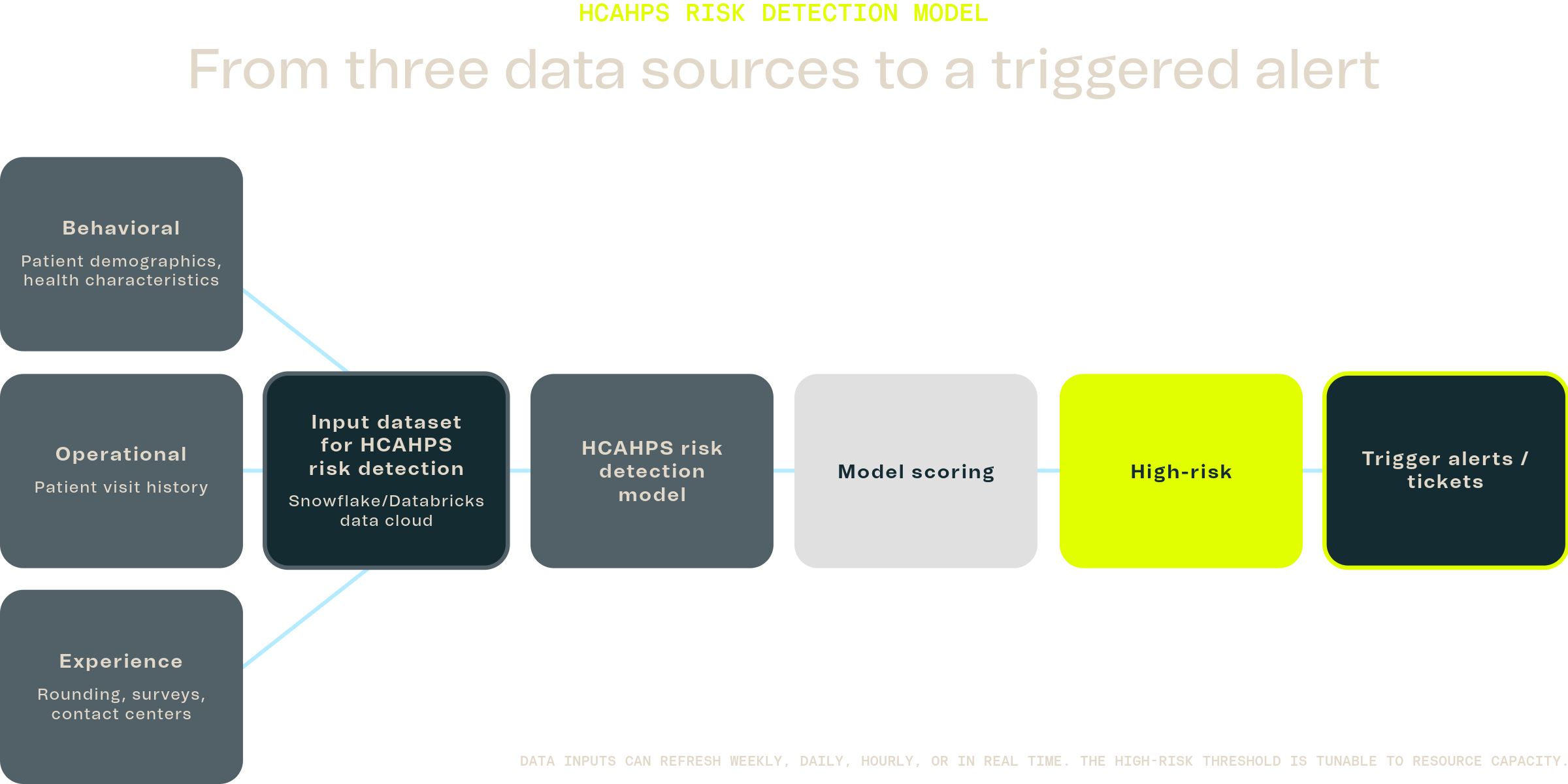
Next, a risk model trains on that hospital's own historical HCAHPS scores. It learns what predicts a low score at that specific hospital.
Finally, the model runs against currently admitted patients. The moment a patient crosses the high-risk threshold—the model acts. A custom AI agent creates a ticket, alerting the rounding nurse assigned to that patient. It doesn't stop there: the agent offers guidance on what that patient needs and why. The nurse intervenes while there's still time. The patient's experience improves. And unit leaders see the pattern building across their floor.
This isn't theoretical—a 2024 quality-improvement study found that giving physicians real-time feedback on admission survey responses improved patients' HCAHPS communication scores by discharge.⁴
Start with a single hospital unit. Walker trains the model against that unit's own historical data. Proves accuracy. Builds trust. Then helps make the business case to expand—unit by unit, until the Early Warning System reaches every unit.
From a report card to real-time practice.
Walker's HCAHPS Early Warning System has real implications across the hospital system: nurses know which patients are at risk—no guesswork required. HCAHPS scores improve. Increased reimbursements follow.
That's the difference between measuring patient experience—and managing it.
Talk with Walker today about how to see risk while you can still do something about it.
¹ Centers for Medicare & Medicaid Services, HCAHPS: Patients' Perspectives of Care Survey. https://www.cms.gov/medicare/quality/initiatives/hospital-quality-initiative/hcahps-patients-perspectives-care-survey
² Centers for Medicare & Medicaid Services, Hospital Value-Based Purchasing Program. https://www.cms.gov/newsroom/fact-sheets/cms-hospital-value-based-purchasing-program-results-fiscal-year-2019
³ "An Exploratory Analysis of the Association between Hospital Quality Measures and Financial Performance," Healthcare, 2023. https://doi.org/10.3390/healthcare11202758
⁴ Bryant, C.E., et al., "Impact of Early Admission Surveys on Physicians' Communication Skills on HCAHPS Scores: A Quality Improvement Initiative," Cureus, 2024. https://doi.org/10.7759/cureus.68616

