Your patients aren't transactions.
Your data shouldn't reduce them to one.
•
4 minute read.

Key takeaways
- A patient’s health is a lifelong journey—but that's not how PX measures it. Yet.
- The data to understand patient journeys already exists. It's time to connect it.
- Walker connects those signals. Retention becomes a decision, not a lagging indicator.
A patient checks in. She sees her doctor. She's discharged. Soon after, she gets a survey: how was your experience today?
She fills it out. Her responses get added to the pool—thousands of patients, across dozens of providers, rolled into a monthly score. The health system can see how patients felt in general about their care this month. Maybe they can compare it to last month.
What they can't see: whether she has become more or less satisfied over time. Whether her experience differs from other patients with the same condition or care pathway. Whether she's at risk of discontinuing care entirely—while there's still time to do something about it.
The survey captured a moment. It didn't capture the journey.
Follow the journey—and see what changes.
Most health systems aren't short on data. They're short on a way to see it together.
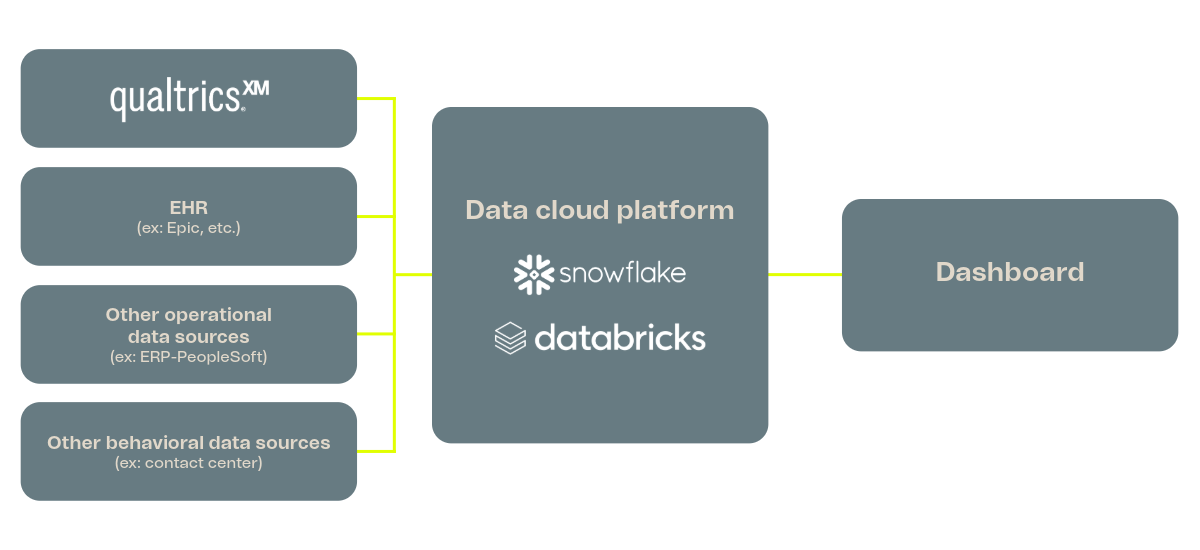
Walker's Unified XM approach connects the signals that already exist across a patient's care experience—operational records, experience feedback and behavioral patterns—and organizes them around the patient's journey. Not the calendar. Not the quarter. The actual arc of care, from first visit forward.
Our Patient Journey Dashboard runs on data cloud platforms like Databricks and Snowflake—the infrastructure that makes connecting operational, behavioral and experiential data possible at scale. Qualtrics connects directly to that foundation, bringing what patients say about their care into the same view as what they do.
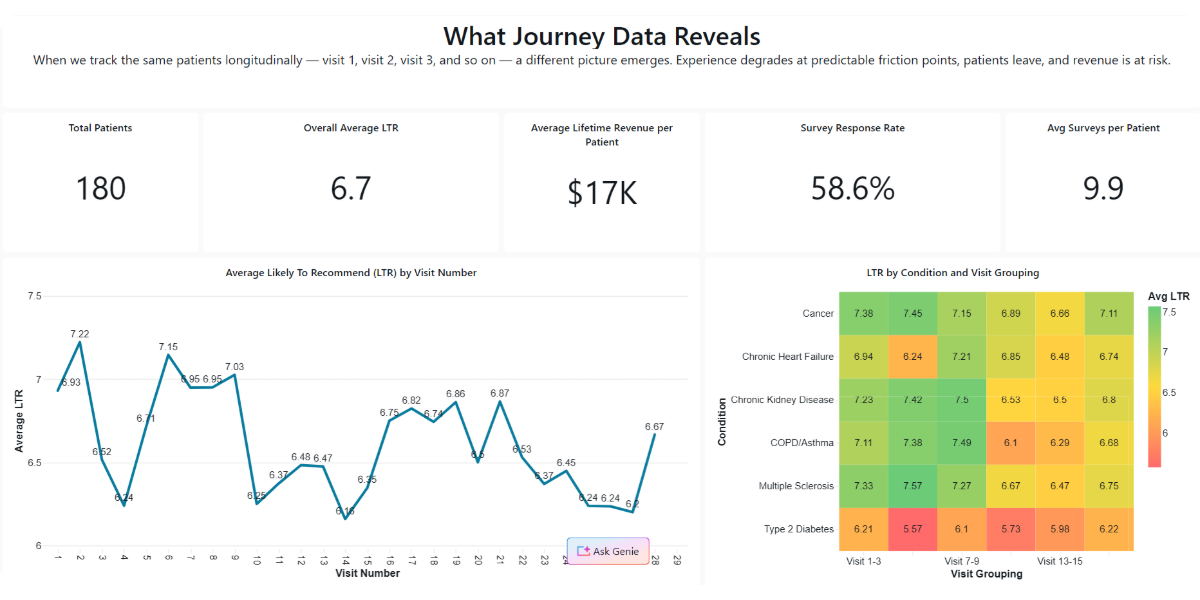
Instead of monthly NPS scores—visit-by-visit snapshots with no context—you can see how experience shifts across a patient's care pathway.
Take the first ten visits of patients managing type 2 diabetes. Scores start strong. They dip at visit four, recover, then plateau. That dip isn't random. It's concentrated in one condition cohort, at one milestone—and the reasons appear in behavioral data weeks before they show up in a score. Rescheduled appointments. Unanswered calls. The care relationship quietly eroding.
The same lens works across cancer care, post-surgical recovery and chronic disease management. Each cohort has its own journey. The dip might happen at visit six or twelve. But no matter when it occurs, the right intervention—delivered at the right time—changes what happens next.

By looking at journeys, satisfaction becomes something you can diagnose, triage and treat the source of—instead of a score telling you what already happened.

You can't retain a patient you didn't know was leaving.
So why haven't patient journeys been the focus?
Traditional PX was built for transactional listening—capturing moments, not following journeys. Operational and behavioral data have always lived in different systems than experiential data: what patients actually say about their care. Different teams owned parts of the whole. Separate systems held the signals. And the architecture was never built to connect them.
Unified XM changes that. Not what gets collected—what gets connected.
Even when patients fill out every survey, the signal can be hiding in plain sight. A satisfaction score that looks stable month over month, but dips over the lifetime of a journey. An overall rating that isn't alarming, but reveals problems when broken down by cohort.
And hidden from the scores—a patient whose engagement with care is declining. Who is already thinking about leaving.
When data is connected around the patient journey, retention becomes a decision. Not a metric explained after the fact.

Walker builds that capability: the data model, the cohort logic, the journey views. Instead of noticing reduced NPS in say, October, you can see that Type 2 Diabetes patients have a satisfaction dip in visits 3-6. And then—you can make changes in their care. Changes that drive up NPS. Changes that prevent no-shows at what was supposed to be visits 8-9. Changes that were only possible because you saw the journey and the operational, behavioral and experience signals—in one spot.
You already have the data. Let’s use it to stop diagnosing what happened. And build journeys you can impact.
Want to learn more? Watch our Patient Journey Dashboard demo.
Stay in the know.
Patient journeys, connected data, what's actually working in healthcare CX. Get insights like this one, regularly delivered to your inbox.

