
Key takeaways
- AI will not wait for organizations to get aligned. It will act on the data it can access, which makes disconnected experience data a business risk.
- XM leaders need to move experience out of the reporting layer and into the decisions that shape retention, growth and customer relationships.
- Unified XM gives organizations a practical way to connect experience, operational and behavioral signals so automation does more than move faster. It moves with understanding
At Qualtrics X4 2026, one theme dominated nearly every keynote and breakout: AI is accelerating faster than most organizations are prepared for
- Autonomous agents.
- Hyper-personalized journeys.
- Decisions happening in milliseconds.
It is exciting. It is energizing. And for many experience leaders, it’s also raising a more practical question.
Are we actually ready for this?
In an engaging breakout session, Walker President Jack Walker and PTC’s Namrata Wadhwa explored what it really takes to prepare organizations for AI-driven decisioning—and why most enterprises are still missing a critical piece.
When data moves faster than experience.
Across industries, automation is rapidly embedding itself into how businesses operate. Executives are under pressure to modernize, boards are asking about AI strategies and teams are being pushed to move faster and operate more efficiently.
But inside most organizations, progress is happening function by function. Digital teams are optimizing conversion, operations are driving efficiency and finance is focused on margin. Each group is solving real problems—but often in isolation.
The result? Data lives in different systems, ownership sits in different departments and metrics aren’t always shared. So when automation begins scaling decisions, it doesn’t wait for alignment—it scales whatever signals are easiest to access. And that’s where risk begins.
Inside most enterprises, not all data moves equally. Operational and behavioral data are typically structured and continuously generated. Experience data, on the other hand, is contextual, often qualitative, and frequently managed by CX teams on a separate cadence.
So when enterprise systems look for inputs to optimize around, they naturally favor what is already structured and centralized—which is rarely the full picture.
As Jack put it during the session:
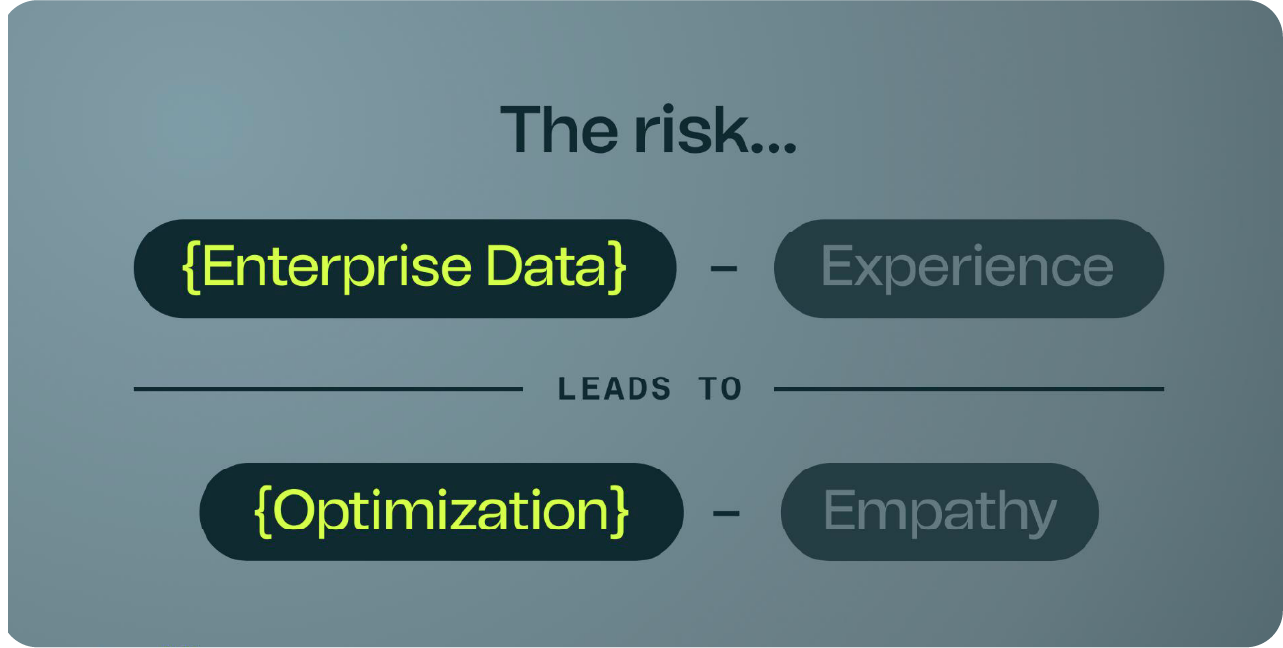
“When enterprise data is separated from experience, optimization happens without empathy.”
Over time, that disconnect shows up in real business outcomes: poor experiences, declining loyalty and lost revenue.
A new role for XM leaders.
This moment creates a clear choice for experience leaders.
Many XM programs today focus on reporting insights—collecting feedback, analyzing sentiment and delivering dashboards across the organization. That work still matters, but it’s no longer enough. Because insight alone doesn’t change decisions—systems do.
The shift is subtle but significant: from reporting on experience to embedding experience into how the business actually operates. From measuring experience to shaping outcomes.
Unified XM: a way of working.
To enable that shift, Walker introduced an approach called Unified XM. It’s not a new platform or another dashboard. It’s a way of working that connects three critical domains of enterprise data:
- Behavioral data: what customers do
- Operational data: what the business measures and manages
- Experience data: what customers think, feel and say
When these signals are aligned, organizations don’t just move faster—they make better decisions. Decisions that are not only efficient, but human-centered.
But getting there requires more than technology. It requires alignment across systems, teams, and ownership—something most organizations underestimate.

How PTC connected experience to revenue.
To bring this to life, Namrata Wadhwa, Senior Director of Customer Experience at PTC—a global leader in product lifecycle management software—shared how her team is approaching this challenge.
PTC already had a mature Voice of Customer program, with listening happening across multiple touchpoints and channels. But there was a gap. Listening wasn’t the problem—connecting those insights to enterprise decisions, especially revenue decisions, was.
To address this, the team launched a focused proof of concept centered on a critical business outcome: churn risk.
By bringing together experience, operational and behavioral signals, they began uncovering patterns that wouldn’t have been visible in isolation. But the real breakthrough wasn’t just in the analysis—it was in what the process revealed:
- Where data didn’t align across systems
- Where experience signals were underrepresented
- Where critical decisions were being made without the full customer picture
This work didn’t just connect experience to revenue. It strengthened how PTC listens, prioritizes and acts on customer signals across the business.
More importantly, it also showed that even early-stage efforts can surface actionable insights—without waiting for perfect data or a fully mature model.
Why this matters now.
As AI continues reshaping how organizations operate, the stakes are rising. Automation will scale whatever signals the enterprise provides—the question is whether experience will be one of them.
As Jack explained during the session, “Without that foundation, AI scales automation. With that foundation, AI scales understanding.”
For XM leaders, the choice is becoming clear: will experience remain a reporting function, or will it shape how decisions are made, how systems are designed and how automation operates?

Want to go deeper?
Register to watch the session on demand.
Jack Walker and PTC’s Namrata Wadhwa revisit their X4 session on Unified XM—taking another look at the Unified XM approach for those who missed the live conversation, want to revisit key ideas or plan to share it with their team.
In this recorded session, they show how Unified XM takes shape inside a real organization, bringing in added context and practical examples.
Submit the form to receive access to the on demand webinar.