The future of customer intelligence is in the data cloud.
5 minute read

Key takeaways
- Disconnected experience data leaves revenue leaders blind to renewal risk and expansion signals, right as boards scrutinize every dollar of AI spend.
- The fix isn't a better tool. It's unifying data so agents and revenue teams work from one picture.
- Walker builds toward that unification now, so AI investment protects revenue instead of becoming another canceled pilot.
Tech stacks are large, and growing. The average organization manages 305 applications today,1 adding 9 more every month—a 35% portfolio growth rate every year.1 Customer intelligence ends up scattered across all of it. And experience data specifically—what customers say—usually lives in a survey platform, walled off from the rest.
Meanwhile, a growing share of the audience that needs this data isn't human. AI agents need data—and they can’t always access the systems that house it.
That blind spot now costs more. Boards want tech investments that are defensible, with measurable impact—AI tools most of all. Gartner predicts organizations will cancel more than 40% of agentic AI projects by the end of 2027 due to escalating costs, unclear business value and inadequate risk controls.2
A 306th application won't connect the data. So how do insights reach the right people in time to act?
Scattered customer intelligence data. One place to connect it.
Customer feedback management platforms are still the best way to collect what customers say. They run the surveys, close the loop with the people who follow up and keep program dashboards current. That work matters, and it stays where it is.
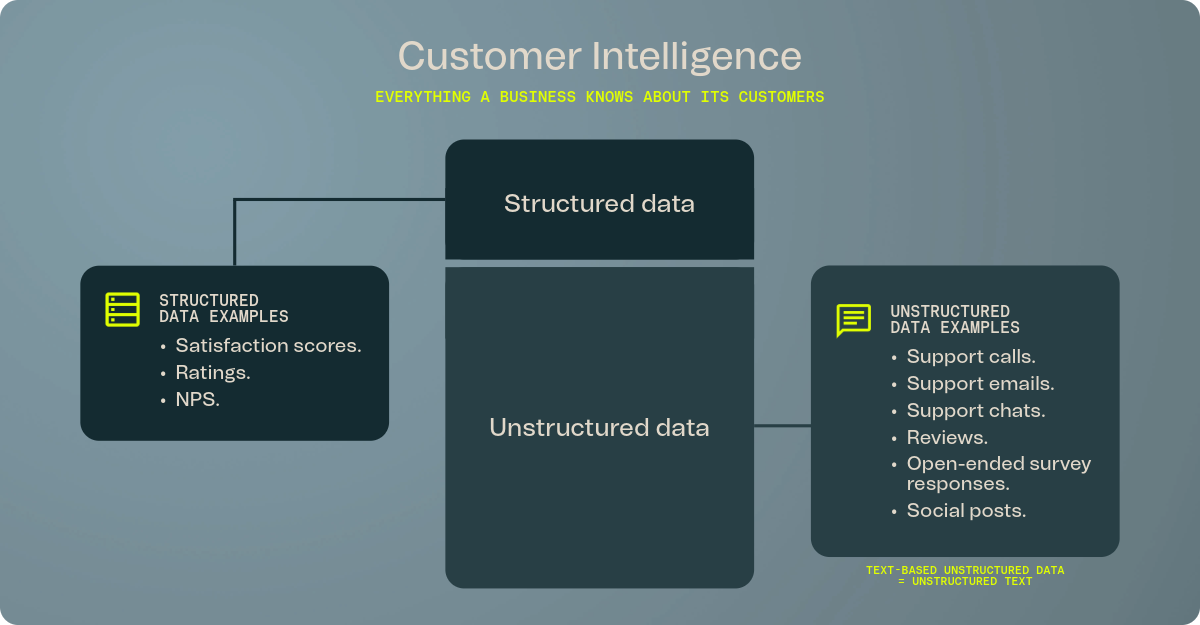
But connecting experience data to the rest of the business in the data cloud solves problems most organizations have tried to address in pieces: different owners, different tools, no shared source of truth.
- No more mismatched data formats. Teams can finally query numbers and free text together, so insights come from both.
- No more scattered governance. One environment sets the rules for who can see data and how teams track it—not five different rulebooks across five different tools.
- No more agent guesswork. Agents need context to succeed. Separate systems leave an agent with part of the picture, and it still answers with confidence, even when it’s wrong. In the data cloud, it works from what customers said, bought, renewed and escalated, so it answers from evidence, not inference.
- No more vendor lock-in. Some platforms make data hard to leave with—it effectively belongs to the platform, not the business. The data cloud connects it under the business’s own rules, open to any model, agent or analytics tool the business chooses.
- No more starting from scratch. This isn't ripping out existing tools—it's connecting what's already there. Databricks reports serving 70% of the Fortune 500,³ and Snowflake reports serving more than 40% of the Forbes Global 2000.⁴
Walker builds agent-ready data foundations inside a client's own data cloud.
We build inside a client's Snowflake or Databricks environment, unifying experience data with revenue, product and support signals so agents and revenue teams work from one governed source.
Building there beats routing data through one more system first. Connection happens where it lives, and Walker meets it there. That’s why we became a Snowflake Select Partner and a Databricks Bronze Consulting Partner.
Walker is building toward a future where experience data takes its place next to everything else a business knows, ready for whoever needs it: a rep prepping a renewal, a CS leader building a quarterly business review (QBR), an AI agent flagging risk.
Customer intelligence doesn’t need a better report. It needs to connect to everything else the business knows—and the data cloud does that, getting it to whoever needs it and protecting the revenue riding on it.
Which systems should connect in the data cloud?
Any system that holds a signal about customers. Those signals already live in systems the business owns. They just don’t sit next to each other.
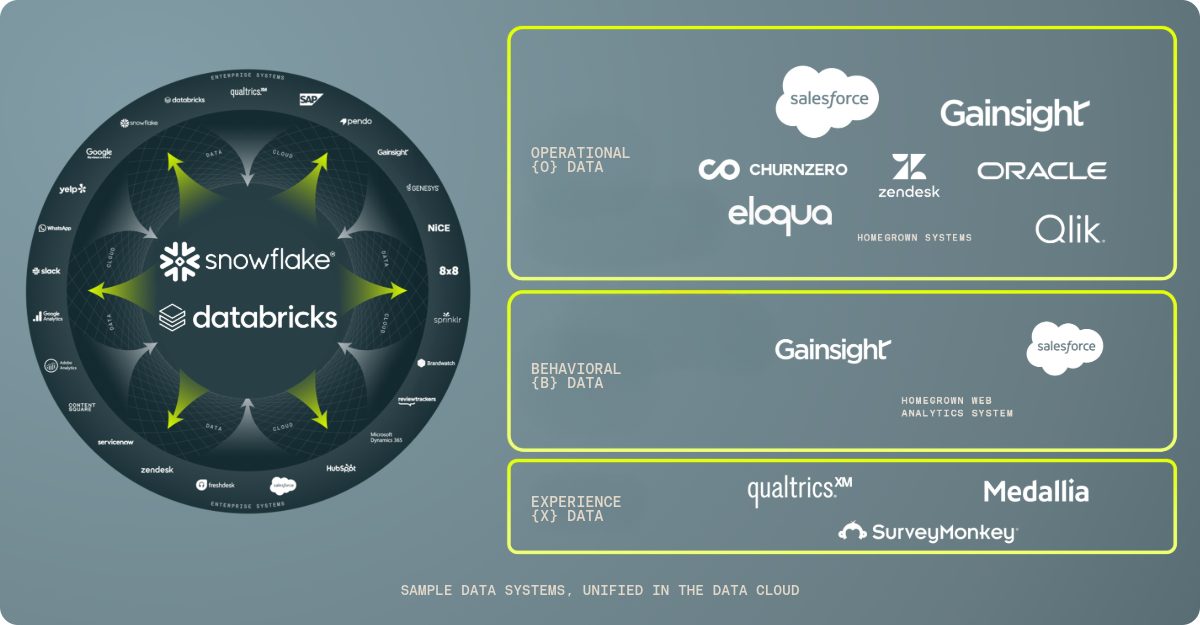
Customer intelligence lives in many systems. Those systems fall into six groups:
- What customers say: survey and experience platforms, plus reviews, call transcripts and chat
- What customers buy and renew: CRM, billing and finance systems
- What customers ask for: support and service tools
- What customers do: product and digital analytics
- What patients’ records show: clinical systems, in healthcare
- Everything built in-house: proprietary systems a company’s own teams created
The survey platform still collects what customers say. It just stops being the only view. Put experience data beside purchases, renewals and support history, and the whole account comes into view.
We start from the stack a client already runs—no rip-and-replace. The data cloud doesn’t care where a signal started. It connects signals under one set of rules, so every team and every agent gets one picture, not five partial ones.
Ready to see how unifying it inside the data cloud could impact your business?
Sources
1 “2026 SaaS Management Index,” Zylo, Inc., 2026.
2 “Gartner Predicts Over 40% of Agentic AI Projects Will Be Canceled by End of 2027,” Gartner, Inc., 2025-06-25.
3 “Databricks Grows >80% YoY, Surpasses $7B Revenue Run-Rate, Scales Lakebase, Genie, and Unity AI Gateway,” Databricks, 2026-08-13.
4 “Earnings call transcript: Snowflake beats Q2 2026 estimates, shares jump 22%,” Investing.com, 2026-09-02.